Showing posts with label Introduction. Show all posts

Thursday, August 30, 2018

Exploring how to make a Dong Ho folk paintings

Dong Ho painting is the exclusive product of the Dong Ho village, a craft village located on the left bank of the Duong River in Bac Ninh Province, about 35 km from Hanoi. Craftsmen in the village often produce their own raw materials for the making such as “điệp” paper mixed with many natural colours.
Many foreign visitors coming to Vietnam always spellbound the special way of making these intriguing painting in Dong Ho painting village – Bac Ninh Province.
Folk painting is one of the special cultural features of Viet Nam. Since the ancient time, there have been a lot of painting villages, such as Dong Ho village (Bac Ninh Province), Hang Trong (Ha Noi), Nam Hoanh village (Nghe An Province), Sinh village (Hue city), and other villages in the south and mountainous areas.
Dong Ho painting are printed by hand on the surface of wooden plate. Each printing color has its own engraved board. The black one is printed last. Thanks to this way, paintings are made in bulk and do not require sophisticated techniques.


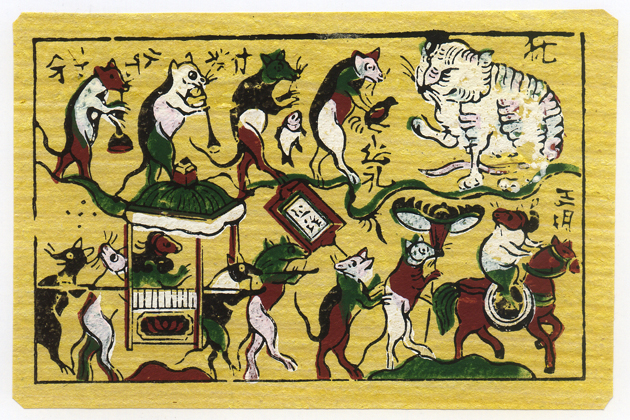
Dong Ho paintings mainly reflect the aspiration for a peaceful, happy and prosperous life. Dear animals in people’s life, such as cow, pig, dog, cat and chicken are also depicted in a lot of paintings. Especially, some paintings like “catching coconuts”, “mice wedding” and “jealously” attract the attention of many domestic and foreign visitors.
The painting fair is annually held on Tet holiday in the communal house in Dong Ho village, which draws a large number of tourists. From the afternoon of March 14th (lunar calendar), shoddy goods competition is also held at the same place. Painting fair is a distinctive cultural feature of Dong Ho villagers.

Dong Ho Painting “Mice wedding”

The printing paper is made from the bark of tree. The background paper is originally white. People use natural materials to change the colors of the paper which are usually orange, pink, yellow, purple, etc. colors of the paintings are refined from various kinds of tree leaves that can be easily found in Viet Nam.


Step 1: Prepare the Do paper

Particularly, the red color is taken from earth of hills and mountains; the black color is from the coal of burned bamboo's leaves; the glitter white color is made of sea shells. The original point of Dong Ho folk painting is the durability of colors. The painting is finally covered with a layer of sticky rice paste to protect the paintings and their colors. They are so long lasting that it is very difficult to make them dimmer due to time or light.


Step 2: Coloring


Step 3: Wood molds engraving


The most common idea carries congratulation meanings, for instance, “Honor-Prosperity”, “Spring Ritual”, “Chicken Family”. Another plot is daily activities, which include “Jealously”, “Playing flute”, “Farmer and Water Buffalo”. Those paintings with Chinese characters have clearer meanings. For example, the painting “Justice” that portraits a child carrying a frog, it usually means humanity and justice.


The last step: Picture printing

Traditionally, Dong Ho painting was an essential element in every Vietnamese family during the Tet Holiday. The colorful tones and optimistic content of the images livened up the house and the picture was considered a good luck sign for the family in the New Year, thus Dong Ho paintings had other names like Tet paintings (tranh Tết) or Spring paintings (tranh Xuân). Before 1945, there were over 150 families in Dong Ho village making pictures. However, the tradition fades rapidly under the dominance of modern life in Vietnam and Dong Ho pictures gradually disappear in Vietnamese families during the Tet holiday. The principal buyers of Dong Ho paintings today are tourists who are interested in traditional arts. Therefore, the villagers can no longer make a living based on this production. Dong Ho painting also has to face the menace from fake pictures which are mass-produced by printing machines. As a result, there are currently only several households in the village that still make Dong Ho pictures while many others have switched to producing joss paper and votive paper objects (vàng mã).


Meaning of pictures

Remember to come to Dong Ho on Tet holiday to mingle yourselves in the atmosphere of a painting fair, which is an opportunity to choose one to your taste.

The Meanings of Dong Ho Folk Paintings

Farmers in Ho Village in Bac Ninh Province north of Ha Noi have a traditional secondary occupation: drawing pictures and printing them on the occasion of Tet. These brightly coloured pictures are drawn, engraved on wood, and printed with rudimentary means on home-made paper coated with white oyster-shell powder…

Farmers in Ho Village in Bac Ninh Province north of Hanoi have a traditional secondary occupation: drawing pictures and printing them on the occasion of Tet. These brightly coloured pictures are drawn, engraved on wood, and printed with rudimentary means on home-made paper coated with white oyster-shell powder. They entrance both old and young. To understand the success of these people’s artists, one must witness the scene of peasants enthusiastically crowding around a picture vendor – usually a woman – in a special rural market held on the approach of Tet. Every family wants to adorn its home with some of these pictures. There is a choice between The Sow and Her Piglets, The Hen and Her Chicks, Jealousy, Master Toad, The Rat’s Wedding, Picking Coconuts, and many others. These pictures strike a fresh note inside dark thatch houses by bringing a good wish, expressing a dream or illustrating a moral precept.


Traditional beauty in Dong Ho paintings

The art of Ho Village gradually decayed under French domination because of competition from foreign production and the colonists’ policy of art assimilation. The sale of drawings of Ho Village became limited to small markets in remote rural areas instead of reaching a large urban clientele. When the Resistance War broke out, artists packed away their paints and brushes, took up rifles or joined groups of evacuees. Many of the wooden engraving plates were burned, chopped up as firewood, or thrown away by the colonialist troops in their raids on Bac Ninh Province.
However, since the liberation of northern Vietnam in 1954 and especially since the unification of the country in 1975, this art in Ho Village has revived, and new groups of artists have formed in other places.
The pictures of Ho Village serve as an important source for scholars studying the history of Vietnamese folk art. Before the 1945 August Revolution, only a few artists – Nguyen Do Cung in particular – took an interest in popular sources. However, since the Revolution, Vietnamese artists have made test drawings modeled on the pictures of Ho Village.
Rat’s wedding

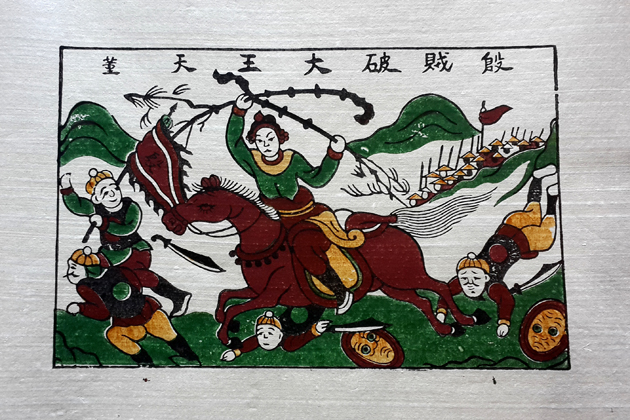
Painters Tran Van Can and Ta Thuc Binh made posters to publicize the fight against illiteracy, to encourage enrollment in the army, and to affirm the struggle for increased production. In so doing, they were inspired by the methods of the peasants of Ho Village, whose drawings are all the more valuable since they are the comparable source of Vietnamese folk that has survived. True, these pictures have not yet gone beyond native subjects and suffer from an obvious lack of technique. However, like folk songs, dances, popular poems and theatre, they testify to the continuity of art speaking to and emanating from ordinary people. Such pictures as The Hen and Her Chicks and The Sow and Her Piglets with their lively strokes show an image of prosperity. Others like The Trung Sisters, Thach Sanh, and Thuy Kieu praise patriotism and fidelity to moral precepts.
In addition, a whole category of satirical subjects denounces the bad habits and manners of the ruling classes. Master Toad makes fun of the scholars who recited sentences all day that they had learned by heart. The Rat’s Wedding mocks the ceremonious and complicated rites of the elite of the time. In this picture, the cat calmly waiting for the fish offered by the rats embodies official corruption. Jealousy shows a husband and his second wife threatened by his first wife is a humorous attack against polygamy. Picking Coconuts is a gay and bold drawing. A woman peasant reveals part of her thighs as she pulls up her skirt to gather coconuts; it is a successful illustration of popular songs and verses deriding the hypocritical “austerity” of official morals. All these very simple pictures breathe optimism as they reflect the people’s daily life and the special features of the peasants’ outlook. It is courageous to attack such sacrosanct social strata as royalty, mandarins, and scholars. These pictures reflect typical characteristics of Vietnamese laborers, who can always find an appropriate way to ridicule their oppressors. From the technical point of view, the artists use simple colors. Green, red, and yellow dominate. In order to make the thatch cottages brighter, the artists exchange actual colors for more lively ones. Painters trained in modern schools are developing and popularizing this art of the people, helping traditional artists improve their technique and find new subjects. In this way, the pictures created by the peasants of H6 Village may continue to flourish.

Monday, August 27, 2018

Related Tours A story of Dong Ho Folk Painting

Among lots of folk paintings of Hang Trong (Hanoi), Kim Hoang (Ha Tay province), Nam Hoanh (Nghe An province), Sinh (Hue city), etc., the paintings of Dong Ho seems to be the most popular. During your trip in Vietnam, you can see this kind of painting hanging on each house, especially whenever the Vietnamese Tet comes since it has been used to be a precious decoration to celebrate the biggest occasion of the Lunar New Year Festival.

Tet Dragon dance, folk art picture from Dong Ho

Particularly, in the past, Vietnamese people bought Dong Ho pictures, hung them on their wall for a year and then replaced them by new ones when a new year was coming. Until now, Dong Ho Painting has not only symbolized for Vietnam’s folk culture but drawn inspiration for many a poets and musicians of Vietnamese generations as well.

What Dong Ho Painting attracts 

Except for each painting’s beautiful lines and lay outs, people are impressed by its folk feature, which is clearly expressed in its color and paper, both of which are handmade and derived from materials available in nature.

What attracts people at first in each Dong Ho painting is its special paper, which is made of bark of tree, called “do”, and powder of seashells and glutinous rice. While the seashells create a sparkling white background, the glutinous rice makes the paper more supple and able to conserve colors for such a long time.

Meanwhile, the second impression is wide range of colors of paint used in Dong Ho pictures, made from various kinds of natural materials, which can easily be found in Vietnamese countryside. For instance, the black color is taken from ash of burned bamboo leaves, the red one is from red gravel and the yellow is from flowers. They’re such striking and lively colors that introduce you the whole Vietnamese village through each line and each color block. 

Dong Ho Folk Paintings in Bac Ninh, Vietnam

Folk painting is a celebration of traditions. In Vietnam, it keeps village life alive in people’s memories while the invasion of industries draws people in the cities. It is a reflection of what the artist actually sees not what she imagines. In that sense, it is a backward looking art resting on history not modern art explorations of twisted visions in the artist’s mind when he looks at something or feels something


Dong Ho is in many ways a traditional small Vietnamese village. One thing making it unique is the remaining 16th century stelae depicting a folk art of two mice pounding rice. A little less than an hour from Hanoi following Highway 1 to Bac Ninh, Dong Ho is one of our best day trips.

Location and History


Nguyen Dang Che guide: how to make a traditional paiting

Dong Ho Village with its famous paintings has become an aesthetic symbol in Vietnam culture. Located to the left side of Duong River, Dong Ho stood for centuries making their unique art work. From over 100 families in the 1950s, currently there are only a handful of families still making the traditional craft. Most villagers have now turned to joss paper making, since the regulation has relaxed and again allowed for religious practices that were once deemed “unfit of the revolutionary”. The families of Nguyen Dang Che and Nguyen Huu Sam both run their own galleries and employ a number of workers. To everyone’s relief, the essence still remains and thrives.


Arts and Symbols
Dong Ho paintings are places for artists to reflect their wishes for lucks and their perception of everyday life in the village. Common themes that are found consistently include animals (which has goodluck symbol on them), everyday life (such as Jealous Fight or A Market Day), and folk tales (Saint Giong or The Frog Teacher). The paper used for the painting is made from bark tree so that the texture can retain color for a long time. Each family develops their own mold for the painting. Each mold are then replicated and filled with a separate share of color. The paintings are made by stamping the mold into the paper, one at a time to add more and more color to the picture.


Dong Ho paintings are simple, meaningful and created for the mass. Patrons use to come from agricultural and low-income families, some of them are illiterate and can not afford other more exquisite art works. But the meaning is the paintings is, by no means, sub-par. It reflects both reality and dream of the people.

Dong Ho these days has also expanded its tradition, and many new products have taken form, among them xyloglyphics and combined-medium works.


Visitor information
A visit to Dong Ho family can take 3-4 hours. For the true art-enthusiasts, skip the amateur Nguyen Dang Che’s tourist-exploiting mill and go sit down and have a talk to the famous but elusive Nguyen Huu Sam or his son Nguyen Huu Qua, who are both masters of their trade

Nguyen Dang Che artisan at his house

Dong Ho's pride is the family folk painting gallery of Nguyen Dang Che, a celebrated artist revelling in depicting the joys of small village life. Through both paintings and wood block reproductions, he and his family create work that is really worthwhile bringing home from Vietnam. When you travel, you should always try to bring home the best that you can afford of countries you’ve visited.

Nguyen Dang Che’s art is among the best. Che himself is a small man filled with energy, working closely with his 4 sons and daughter. Each family member seems to have a task in producing the prints and paintings. The technical skill in cutting the wood blocks for the prints is a delight to watch. 
 Picture

Dong Ho families still own many of these traditional blocks used for folk painting. This village used to be the centre of folk painting which is popularly used by the Vietnamese to wish happiness, good luck and fortune during TET, the Vietnamese New Year. In the past, just before TET, the village used to hold in its communal house a market for its folk paintings.


The mixing of colours of traditional herbs, tree leaves, charred bamboo, ground oyster shells and red earth is an art in itself. You can see in Nguyen Dang Che's workshop all these traditional items used for folk painting. The traditional paper, Zo, is wonderfully textured and helps focus on the quality of the over-all effort. It is made from the fibre of the bark of a papyrus like plant coated with oyster shell dust called "diep" by the locals. The Thai minority in Vietnam were the first to make this type of paper and still continue to do so. Originally, it was only used for writing poetry until the Dong Ho families discovered that once coated, it is perfect for folk painting.

it's take around 01 month to finish...

It costs around 10 to 50 million VND (USD1.000$ - USD 3.000$) for one


The grounds where Che paints have traditionally built workshops and are of themselves worth a visit to see the village craftsmanship that has remained largely unchanged for a thousand years. Filled with light and warmed by the wood, it’s a perfect setting for an art community.

Nature material to make Dong Ho paiting

Nature material to make Dong Ho paiting

Dong Ho is next to a river, the Duong, and is a verdant and fertile village giving the feeling of timelessness. Village markets are perched precariously on bridges and along the road with all the seasonal fruits and vegetables being eagerly promoted by cone hatted farmers.


So visiting Che and his family is a great experience that includes not only the final art work but also a quick peek into the thousand year old village life that forms the basis of the craft. A little more than an hour from Hanoi, it’s really a half day’s visit and if combined with the famous duck lunch in Bac Ninh, it will be an experience you’ll remember well each time you look at Che’s wood cut or painting on your wall.


Old Dong Ho Painting (Quang Trung - Nguyen Hue) cost more than USD 2.500$ not for selling...

SOME FAMOUS DONG HO PAITING:
Relaxing on the field

Rat wedding and cat

Fighting between jealous wives

04 supernatural power animal (Long - Ly - Qui - Phuong)

Wrestling

A typical mandarin

Lion dance

Peacock


Monday, August 20, 2018

Introduce Vietnamese Dong Ho Folk Painting


Dong Ho painting (Vietnamese: Tranh Đông Hồ or Tranh làng Hồ), full name Đông Hồ folk woodcut painting(Tranh khắc gỗ dân gian Đông Hồ) is a line of Vietnamese folk painting originating in Đông Hồ village (Song Hồ commune, Thuận Thành District, Bắc Ninh Province).

Using the traditional điệp paper and colours derived from nature, craftsmen print Dong Ho pictures of different themes from good luck wishes, historical figures to everyday activities and folk allegories. In the past, Dong Ho painting was an essential element of the Tết holiday in Vietnam; this tradition has gradually declined under the influence of modern types of painting and fake Dong Ho products. However, the art of making Dong Ho pictures is always considered a symbol of traditional culture and aesthetic value of Vietnam. 

With the consent of the Prime Minister, the Ministry of Culture, in collaboration with the Provincial People's Committee of Bắc Ninh and the specialized agencies conducting research, have set records for Đông Hồ folk paintings to be submitted to UNESCO for the recognition of intangible cultural heritage.